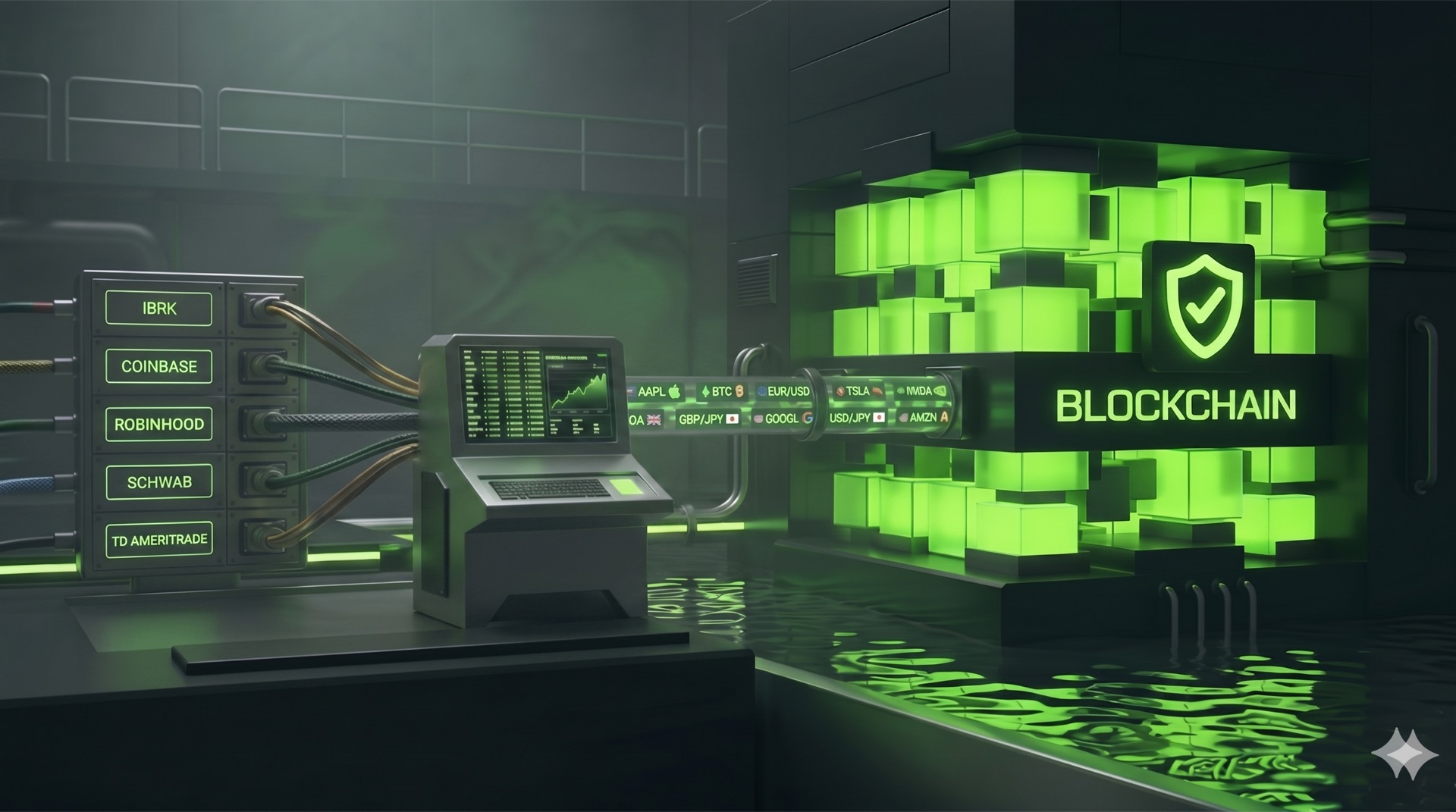
Imagine you’re looking to hire an investment manager. He sends you a PDF with his trading history. Impressive performance: +185% over three years. Sharpe ratio of 1.8. You want to believe.
But who guarantees he didn’t edit that PDF? That he didn’t pick only the trades that worked out? That the history he shows you today is the same one from six months ago, before those two bad months he conveniently removed?
The conventional answer: you trust him. You research, talk to other clients, ask for bank statements, hire an auditor.
Our answer: you don’t need to trust. You verify.
The Problem With Traditional Track Records
Track records in the investment industry have always relied on institutional trust. Auditors stamp reports. CFAs sign attestations. Official platforms store history. All these layers work — until they stop working.
Auditors can be pressured. Attestations can be issued in haste. Platforms can edit records silently. Financial market history is full of track records that looked impeccable until someone took a closer look years later.
What was missing was a way to mathematically prove — without depending on any institution that can fail — that a set of trades existed in that exact configuration, on that exact date.
That’s the problem we solved.
The Hash Chain
Every trade you record on our platform receives a mathematical signature called a hash. This signature is calculated not only from that trade’s data — ticker, price, quantity, date — but also from the signature of the previous trade.
The result: trades form a chain. Every link is mathematically connected to the one before it.
Why does that matter? Because tampering with any link in the past breaks every link that follows. If someone tries to edit an old trade — change the price, the quantity, the date — every subsequent signature becomes invalid. Anyone running the verification detects it instantly.
That’s already powerful, but it’s not enough on its own. The chain proves internal integrity, but not the date. How do you prove when it was created?
That’s where Bitcoin comes in.
The Newspaper Analogy
You’ve seen those old videos where someone needs to prove they’re alive on a specific date? The person holds up the day’s newspaper, shows the headline, references something fresh from the news.
Why does that work as proof? Because no one can travel back in time and produce yesterday’s newspaper with tomorrow’s headline. The newspaper’s date is a public, irreversible time anchor.
The Bitcoin blockchain is the newspaper — only much more robust.
60,000+ nodes · 15 years of unbroken history · $2T+ securedEvery ten minutes on average, a new Bitcoin block is published to the global network. That block contains a timestamp, a mathematical identity, and gets recorded on thousands of computers spread across the planet. There’s no way to fake the date. To alter an old Bitcoin block, someone would need to redo all the computation accumulated since that date — billions of dollars in hardware and energy — and still convince more than half the global network to accept the new version. It’s economically irrational. It has never been done.
Periodically, we publish your trade chain’s most recent signature inside a Bitcoin transaction. When that transaction enters a block, your entire portfolio gets mathematically stamped at that date and time.
Current hash of your entire portfolio historyd8f2b6c9...a4e7d1f3
Hash embedded in a Bitcoin transaction via OpenTimestampsBlock 894,412 · 2026-04-26 02:00 UTC
The Bitcoin network confirms: this exact portfolio state existed at this exact timeImmutable · No one can change it — not even AlphaProof
Compare your current chain hash against the Bitcoin anchor. If they match, the record is authenticNo trust required — math and Bitcoin prove it
From that moment on, no one can alter your trade history without leaving a trace detectable by anyone, anywhere in the world, forever.
What This Enables in Practice
After your portfolio is anchored on Bitcoin, anyone can take three things: the Bitcoin block where your portfolio was anchored, the set of trades you published, and the verification tool we make openly available — and recompute the entire chain. If the hashes match, it’s mathematically proven: those trades existed exactly that way, in that exact order, on that date.
You don’t need to trust us. You don’t need to trust the broker. You don’t need to trust anyone. The math does the work.
Where This Changes the Game
Why Bitcoin Specifically
We chose Bitcoin not for hype, but because it’s the only blockchain with two properties simultaneously:
Immutability proven over more than a decade. Bitcoin has processed trillions of dollars per year for fifteen years. The network’s security has been tested by every kind of attack. Attacking Bitcoin to alter old history is economically irrational.
Decentralized custody. Bitcoin has no CEO, no central server, no delete button. Even if our company disappears tomorrow, the anchors remain there, verifiable forever, by anyone, anywhere in the world.
Important: we don’t issue a token. There’s no crypto involved for the user. We simply use the most robust infrastructure in the world as a digital notary.
For the Technical Reader: How It Works Under the Hood
For anyone who wants to understand the exact mechanism — because “math proves it” deserves the math on display — here’s the full anatomy.
The Hash Function
We use SHA-256, the same algorithm Bitcoin uses internally. SHA-256 is standardized by NIST, audited for over two decades by the global cryptography community, and has never had a practical collision discovered.
It’s a one-way mathematical function: you feed any data of any size in, and it spits out a 256-bit string (64 hexadecimal characters). Two properties matter:
Deterministic: the same input data always produces exactly the same hash. Always. On any machine, in any language, in any era.
Avalanche effect: changing a single bit of the input data produces a completely different hash, with no visible pattern. Take a trade identical to yours, change shares: 100 to shares: 101, and the resulting hash bears no resemblance to the original. There’s no such thing as a “small adjustment” — any change is cryptographically obvious.
The Chain Structure
Each trade you record receives the following immutable fields: ticker, direction (BUY/SELL/SHORT/COVER), share quantity, price, fees, currency, asset class, and execution timestamp.
These fields are concatenated with the previous trade’s hash and passed through SHA-256:
tradeHash = SHA256(
  previousHash
  + ticker
  + direction
  + shares
  + price
  + fees
  + currency
  + assetClass
  + executedAt
)
The first trade in a portfolio uses the string GENESIS as its previousHash. Every subsequent trade references the tradeHash of the one before it. Hence the name chain.
Why does this matter in practice? Suppose someone tries to change the shares of a trade in the middle of the chain. That trade’s tradeHash becomes different. But the next trade still references the old hash in its previousHash. Immediate conflict. Invalid.
To forge a single trade, you’d need to recompute it AND every subsequent one. And even then, the Bitcoin anchors have already locked the old version in stone — any independent verifier runs two calculations and detects the divergence.
The Bitcoin Anchor via OpenTimestamps
We don’t publish each trade individually in a separate Bitcoin transaction — that would cost a fortune in network fees. Instead, we use an open-source protocol called OpenTimestamps, created by Peter Todd and in production since 2016.
OpenTimestamps works like this: it aggregates thousands of different hashes into a single Merkle tree (a binary structure where each node is the hash of its two children). Only the root of that tree gets included in a Bitcoin transaction, using the OP_RETURN field — up to 80 bytes of arbitrary data permitted per transaction. It costs cents.
When that transaction enters a confirmed Bitcoin block, everyone who was in the Merkle tree gets their hash mathematically proven at that timestamp. OpenTimestamps generates a .ots file (a few kilobytes at most) that demonstrates the cryptographic path from your individual chain to the anchored root.
The beauty of it: independent verification of an .ots file doesn’t need our company, our server, or our code. You download the .ots, run the OpenTimestamps client locally (available in any language, as a CLI executable, or via web at opentimestamps.org), and it validates against whatever Bitcoin node you choose. If you want to be paranoid, run it against your own Bitcoin node.
What This Proves Mathematically
When someone runs the full verification of your track record, three things are mathematically proven:
Every hash links correctly, from GENESIS to the latest trade. No trade was altered, removed, or inserted afterward — any tampering breaks the sequence.SHA-256(previous + trade_data) = stored_hash ✓
The trade sequence cannot have been reorganized. Each link points specifically to the previous one’s hash, so swapping the order produces different hashes throughout the rest of the chain.trade[n].previousHash === trade[n-1].tradeHash ✓
The complete state of the chain at that moment already existed before the Bitcoin block that anchored it. You can’t retroactively claim a trade was made before the anchor without it having been included in it.OTS proof → Bitcoin block #894,412 → 2026-04-26 02:00 UTC ✓
The math is exactly the same Bitcoin itself uses to secure trillions of dollars in transactions daily. No corner-cutting, no “lite” version.
Verifying It Yourself
Every public portfolio has an accessible verification page. There you’ll find the chain’s current tailHash, the last confirmed Bitcoin anchor, the block height and timestamp, the .ots file for download, and a direct link to mempool.space showing the actual Bitcoin transaction.
You can run full verification in three independent steps:
- Download the JSON containing all the portfolio’s public trades
- Run the verifier (open-source, or reimplement in any language — SHA-256 is everywhere)
- Validate the .ots against any Bitcoin node (public or your own)
If all three steps match, it’s mathematically proven. Without trusting anything but Bitcoin itself.
This Should Be the Standard
We believe verifiable track records should be the default, not the luxury. That every manager, every trader, every investor should be able to mathematically prove what they did — without depending on any institution that can fail, be bought, or disappear.
That’s why we built this.
The next time someone asks for proof of your track record, you send them the verification link. All it takes is five minutes from whoever’s on the other side.
The math does the rest.